Can You Bring a Service Dog to Mackinac Island? Ferries, Horses, Hotels, and What to Expect
Mackinac Island can be a welcoming place to travel with a service dog, but it is also unusual. Ordinary visitor cars are prohibited, although limited emergency and essential-service vehicles operate. Downtown includes paved streets and sidewalks, while some interior trails have packed limestone, gravel, steep grades, or uneven surfaces. Horses, bicycles, crowds, and ferry travel also require advance planning. If you rely on a trained service dog, this guide explains what handlers should expect before arriving.
Your Rights Under the ADA Still Apply on the Island
Federal ADA protections generally apply to public accommodations and state or local government services on Mackinac Island. Under the ADA, a service animal is generally a dog individually trained to perform work or tasks for a person with a disability. Service dogs are normally permitted in hotels, restaurants, shops, museums, and other areas open to the public. When the dog’s role is not obvious, staff may ask only whether it is required because of a disability and what work or task it has been trained to perform. They may not ask about the person’s diagnosis, demand certification, require a special vest or identification card, or ask the dog to demonstrate its task.
What Businesses Cannot Charge or Require
Hotels cannot apply a normal pet fee, routine cleaning fee, or pet deposit to a service dog, and they cannot restrict a handler to designated pet rooms. However, a hotel may charge for actual damage if it applies the same damage policy to other guests. A business may require a service dog to leave if it is not housebroken or is out of control and the handler does not take effective action. Access may also be limited in the uncommon situation where the animal creates a legitimate direct safety threat or fundamentally alters the nature of a service. Emotional-support and comfort animals that are not trained to perform disability-related tasks do not receive the same public-access rights under the ADA.
Getting There: Ferries and the Crossing
The ferry crossing is usually short, but travel time and vessel layout vary by route, operator, weather, and boat. Shepler’s confirms that leashed or caged pets are welcome on regular island departures at no additional charge, so a service dog does not need a separate ticket there. Accessibility also differs by vessel: all Shepler’s motor vessels provide ramp access to the aft deck, while some older vessels have steps to the enclosed cabin and upper deck. Ask the operator or a crew member about the safest and most comfortable boarding area for your specific needs.
Before You Board
Give your dog a real relief break in the mainland parking lot before you walk to the dock, because once you are in line, on the boat, and then walking into a crowded downtown, it can be a while before you find a good patch of grass. Bring water, since the boats are breezy but the docks bake in the sun. If your dog is new to boats, the engine noise and the vibration through the deck are the two things most likely to surprise it, so a practice session on a smaller vessel at home pays off. Our complete guide to Mackinac Island ferry costs is useful for planning the rest of the trip logistics around your crossing.
The Horses: The One Truly Unusual Factor
This is the part with no match anywhere else, and it deserves real thought. Several hundred horses work the island in summer, pulling carriages, taxis, and freight drays through the same streets you will be walking. Most service dogs handle it beautifully, because a well-trained dog that ignores traffic and crowds usually ignores horses too. But some dogs have simply never seen a horse up close, and a huge animal coming around a corner is a real surprise. If you can get your dog around horses before the trip, do it, even if it is just a few calm visits to a stable at home.
Sharing the Road Safely
Once you are on the island, the rules of the road are mostly common sense. Keep your dog on the right side of the street and close to you, since carriages, drays, and bicycles all share the same narrow streets and everyone is safer when people move in ways others can predict. Do not let your dog walk up behind a working horse, and do not stop in the middle of the street to take a photo. If a carriage is coming and the street is busy, stepping to the side for a few seconds costs you nothing. The island’s drivers deal with crowds all day, and they will read your body language, so make it easy for them.
Managing Barking and Stress Around Horses
A dog that barks at horses creates a safety problem rather than just an annoyance, and it is the fastest way to draw the wrong kind of attention on the island. This is exactly the sort of behavior a trained service dog should not show, but heat, tiredness, and too much noise can push any animal past its usual limits. If your dog starts reacting, get off Main Street, find a bench in a quieter corner, and let it settle before you go on. The side streets a block or two uphill are far calmer than the harbor front and are often all it takes to reset.
Where You Can Go With Your Dog
Service dogs are generally permitted in public-facing businesses and government facilities, subject to the ADA’s limited safety and behavior exceptions. Mackinac State Historic Parks specifically confirms that service animals are permitted at all its sites and in all buildings, including Fort Mackinac. Mackinac Island Carriage Tours describes its regular public tour as pet-friendly; small dogs may ride on a lap, while dogs weighing 35 pounds or more may require a child ticket. Because individual services and conditions can change, confirm arrangements directly when space, horse safety, or accessibility is a concern. State-park trails provide scenic walking, but surfaces, grades, shade, and crowds vary by route.
Surfaces and Paw Care
Give some thought to your dog’s feet. Downtown pavement gets hot in July and August, the interior trails are packed limestone gravel that can be sharp on soft pads, and there is more walking involved in a Mackinac day than most visitors expect because there is no other way to get around. Check paws in the evening, bring booties if your dog is used to them, and plan shorter outings with real rest in between rather than one long march. Water is the other constant, since shade is plentiful on the trails but drinking fountains are not, so carry a collapsible bowl and refill it whenever you pass a restaurant.
Lodging, Medical Backup, and Practical Planning
Call your hotel ahead even though you do not have to. You are not asking permission, you are asking useful questions: whether a ground-floor room is open, where the nearest grass is, whether housekeeping should skip the room while your dog is in it, and where bags get dropped when the dray delivers them. Most Mackinac hotels are small, old, and staffed by people who will gladly tell you the quietest corner of the building if you ask. Our disability travel guide to Mackinac Island and our guide for travelers with limited mobility go deeper on accessible routes and which attractions handle wheels and slow walking best.
If Something Goes Wrong
Veterinary services and emergency availability can change, and full-service care may require travel to the mainland. Before your trip, ask your lodging or local visitor services about current veterinary options and save the contact details for mainland clinics. Bring your dog’s regular medication, vaccination records, a recent photo, and your veterinarian’s phone number. Also check the day’s ferry schedule and ask the ferry operator about urgent-travel procedures. These preparations are sensible because island transportation and weather can make off-island care less immediate than it is at home. If you want the broader picture of how dogs fit into island life, our post on visiting Mackinac Island with dogs covers leash rules and etiquette in more depth.
Conclusion
Strip away the horses and the ferry, and Mackinac is close to ideal for a service dog team. There is very little motor-vehicle traffic, many central destinations are walkable, and island residents and workers are accustomed to sharing roads with horses, bicycles, and pedestrians. A little preparation around horses, heat, and paw comfort turns a trip that sounds complicated into one of the easier destinations you will visit together.
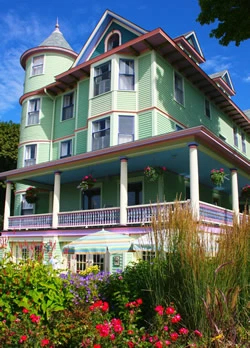
When you are ready to plan it, stay somewhere central so your dog is not covering unnecessary miles at the end of a long day. Inn on Mackinac sits a short, level walk from the ferry docks, Main Street, and the harbor, with a wraparound porch that makes an excellent place to rest between outings. Book your stay with Inn on Mackinac at innonmackinac.com, and let us know what you and your dog need so the room is ready when you arrive.
Category: Mackinac Island