Governor’s Summer Residence on Mackinac Island: History and What Visitors Can See
Most visitors walk right under it without knowing what they are looking at. High on the bluff above the harbor, just past Fort Mackinac, a wide white cottage with green shutters and deep wraparound porches watches over the Straits. It looks like every other grand summer home on that stretch of road, only bigger and better kept. It is actually the Michigan Governor’s Summer Residence, the official warm-weather home of the state’s chief executive, and it has been used that way since 1945.
The house is one of the more interesting stops on the island precisely because it is not a museum in the usual sense. Real governors stay here, and their families spend real summers on that porch. The residence has occasionally hosted public tours in earlier years, but current official visitor information states that it is not open to the public. Visitors can still appreciate its history and view the property respectfully from public areas.
Where the Governor’s Summer Residence Sits on the Island
The residence stands at the corner of Fort Street and Huron Road, right at the top of the bluff where the ground drops away toward the harbor. It is close to Fort Mackinac and can be viewed from the surrounding public roads. The setting is the whole point. From the porch, the land falls away to the golf course, the Grand Hotel spreads out to the west, and on a clear day the Mackinac Bridge stands on the horizon like a pencil line. It is arguably the best residential view in Michigan.
Finding It on Foot from Downtown
From Main Street, walk uphill toward Fort Mackinac and follow the current park map or posted directions to the corner of Fort Street and Huron Road. The climb is steady rather than steep, but it is a genuine hill, so give yourself ten to fifteen unhurried minutes from the ferry docks. Carriage tours pass the house and drivers usually point it out, though you will not be able to stop and linger. To stretch the walk into a proper outing, continue west afterward along the row of historic West Bluff cottages that most tourists breeze past.
What You Can See from the Road
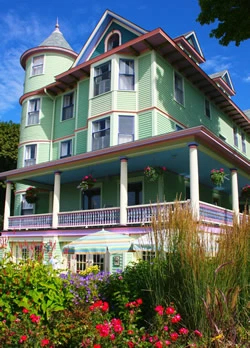
Although access is restricted, portions of the exterior can be viewed from nearby public roads. You can take in the full front elevation, the porch columns, the shingled roofline, and the flower beds along the fence without setting foot on private ground. Morning light works best here, because the sun comes over the harbor behind you and lights the white siding cleanly. Do keep to the sidewalk, respect any posted signs, and remember that a family may well be living inside. Respect all barriers, security instructions, and posted signs, especially when the governor is in residence.
Can You Tour the Governor’s Summer Residence?
Current Mackinac State Historic Parks visitor information states that the Governor’s Summer Residence is not open to the public. Public access policies can change, so visitors should consult the official park website before travelling and should never enter the grounds without authorization.
Understanding Earlier Public Tours
Weekly public tours were offered during some earlier seasons, which explains why older travel guides still mention them. Those historical schedules should not be used for current trip planning. Confirm any future special access only through Mackinac State Historic Parks.
How to Visit Respectfully
View the residence only from public roads and observe all signs and security boundaries. Pair the stop with nearby Fort Mackinac and other publicly accessible historic sites. Conditions and access restrictions may change when the governor is present, so follow instructions from park or security staff.
The House Before It Belonged to Michigan
The residence started life as a private summer cottage and was never designed to be a government building. In 1895 the Mackinac Island State Park Commission began leasing bluff-top lots to summer people, with a condition attached: build a cottage worth at least three thousand dollars on the site within a year. The fourth of those leases went in 1901 to Lawrence Andrew Young, a Chicago attorney with the means to build something considerably grander than the minimum. That origin story explains why the place still feels like a home rather than an institution.
Lawrence Young and the West Bluff Lease
Young hired the Chicago architect Frederick W. Perkins, who had trained at MIT and at the Ecole des Beaux-Arts in Paris, and brought in the island contractor Patrick Doud to build it. Construction was finished in 1902. The result was a shingled, Arts and Crafts-influenced summer house on a limestone foundation, with the third floor tucked into a broad hipped roof and chimneys built from island stone. The Young family kept the cottage into the 1920s, after which it passed to the Hugo Scherer family of Detroit. By then the bluff had become one of the most desirable summer addresses in the Midwest.
How the Cottage Was Built
The scale of the place is easy to underestimate from the road. The house runs to more than seven thousand square feet, with eleven bedrooms and nine and a half bathrooms across a basement and three floors. Michigan white pine was used on the exterior and Georgia yellow pine inside, and the long open porches were built to catch the breeze off the water. Everything about the design assumes a large family, a full staff, and a summer that lasts months rather than a weekend. That generosity of space is what made it useful to the state four decades later.
How Michigan Bought a Cottage for $15,000
In 1944 the house came up for sale and the Mackinac Island State Park Commission bought it for fifteen thousand dollars, for use as an official summer residence. The state wanted a place to host the annual Governors’ Conference, and the bluff cottage offered enough bedrooms to sleep a whole delegation with room to spare. Since 1945 it has served as the official summer residence of Michigan’s governor, and while no governor is required to use it, most have, several treating it as a genuine family retreat rather than a ceremonial address.
The 1945 Renovation Rush
Turning a private cottage into a state residence in a matter of months took an unusual workforce. Prisoners from Michigan state prisons were brought to the island to help with the renovation, working to get the house ready for the thirty-seventh annual Governors’ Conference in July 1945. Michigan’s First Lady at the time, Anne Kelly, oversaw the effort and had a strong hand in the furnishings. The deadline was met, the conference went ahead, and the arrangement stuck.
The Gazebo, the Governors, and the Guests
Two details tend to surprise visitors most. The original gazebo created for the 1980 film Somewhere in Time was placed on the residence property after filming. In 2005 it was moved to its present location along Anne’s Tablet Trail near Fort Mackinac, where visitors can see it today. Our separate gazebo guide explains its film history and current location.
Plan Your Stay on the Bluff Side of the Island
The Governor’s Summer Residence rewards travelers who stay overnight rather than racing back to the last ferry, because the best light and the quietest sidewalks come early in the morning. Inn on Mackinac provides a convenient Main Street base near the route up the hill, so you can be up on the bluff before the day-trippers arrive and back downtown for a second cup of coffee. Book your stay with Inn on Mackinac and give yourself the mornings on this island, not just the afternoons.
Category: Mackinac Island